An integrative somatic approach
My approach is holistic and non-pathologizing. I don’t draw from a single method or ask you to fit yourself into a particular model. My work is experiential and relational, shaped over more than 30 years across neuroscience, clinical practice, trauma work, embodiment, movement, attachment, and the study of how human beings adapt and change.
Symptoms and protective patterns are meaningful adaptations rather than problems to be corrected.
Depending on what’s happening for you, we may notice nervous system activation and settling, developmental and attachment patterns, sensation and movement, protective responses, relationship, boundaries, early reflexes, emotion, meaning, or the way your body has learned to organize around safety and connection.
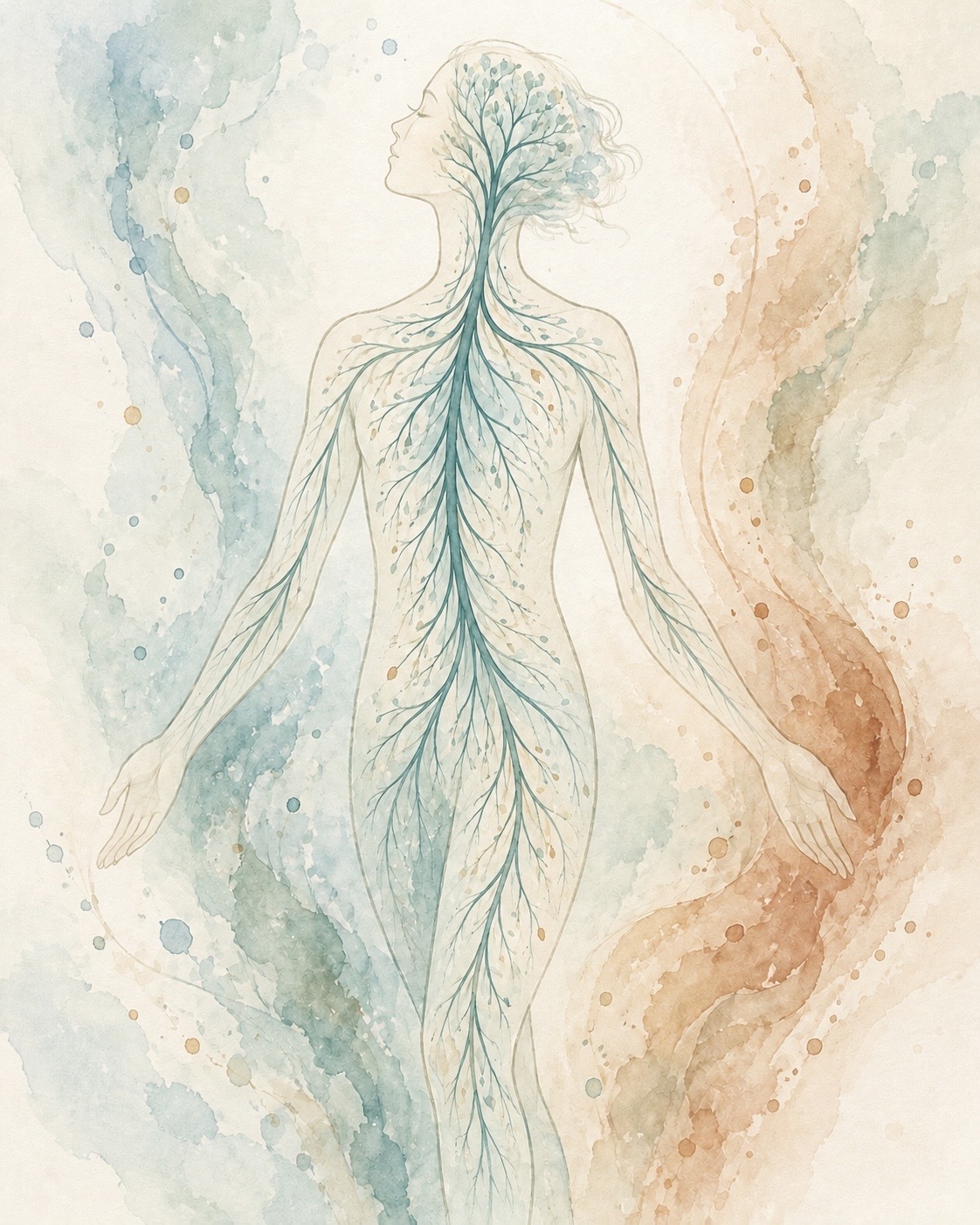
In our work together
Collaborative and paced with care
You don’t need to tell your story in detail or repeatedly revisit traumatic experiences. We can work with what is showing up now — in sensation, movement, emotion, impulses, boundaries, and relationship — while paying attention to what helps you stay connected to yourself.
Nothing you need to perform or do correctly.
A session may include conversation, noticing sensation or movement, orienting to your surroundings, exploring an impulse, or slowing something down.
There’s no right way to have a body, a nervous system, or a response.
Approaches that inform my work
These approaches are woven into my work rather than offered as separate techniques; I draw on them fluidly from a broad foundation in trauma, neuroscience, embodiment, development, and relationship.
Somatic Experiencing®
Somatic Experiencing® is a body-based approach to working with trauma, chronic stress, and nervous system dysregulation. Rather than beginning only with the story of what happened, we pay attention to how your body is responding now: where there is tension or ease, activation or settling, and impulse to move forward or away, or places where you may feel numb, disconnected, or stuck.
I’m a Somatic Experiencing® Practitioner (SEP), having completed the full three-year professional training along with extensive consultation and personal sessions. It’s one of the foundational frameworks that shapes how I understand trauma and nervous system responses.
Trauma can come from experiences that were too much, too fast, or happened without enough support. Sometimes that’s a discrete event, such as an accident, medical procedure, loss, assault, or other overwhelming experience. Sometimes it develops gradually within relationships and environments where safety, attunement, or realiable connection weren’t consistently available.
We don’t need to force your nervous system back into the past in order to work with what it carries. Instead, we move in manageable increments, noticing both activation and the places your system already knows something about steadiness, support, or possibility. Over time, responses that once had to remain rigid or automatic can become more flexible.
The goal isn’t to make you calm all the time. It’s to help your nervous system develop greater range and capacity so activation can rise and fall, settling doesn’t require shutting down, and you have more choice in how you respond to what’s happening in your life.
Transforming Touch®
Transforming Touch® is a regulation-focused approach developed specifically for developmental trauma, including experiences that occurred before language and explicit autobiographical memory were available. Because some of our earliest patterns of safety, attachment, and protection were formed before we could understand or tell a story about what was happening, insight and language may not be enough on their own to reach them.
The work uses safe, intentional touch, and other forms of embodied, relational support to develop somatic trust, attachment, co-regulation, and a growing sense of safety in the body. During online sessions, this work is offered virtually without physical contact. It can include attention to very early protective responses and primitive reflexes that may remain active when development has been disrupted.
As a Transforming Touch® Practitioner (TTP), I often draw more heavily on this approach when the trauma is early, developmental, relational, or pre-verbal. While Somatic Experiencing® and Transforming Touch® overlap in their attention to the nervous system, Transforming Touch® gives us a way to work directly with those early embodied patterns when someone’s difficulties are rooted out only in what happened to them, but also in how safety, attachment, and regulation were shaped during early development.
Embodied Recovery for Eating Disorders
Embodied Recovery for Eating Disorders (ERED) brings a trauma-informed, body-based perspective to eating-disorder recovery. Rather than treating eating-disorder behaviors simply as symptoms to eliminate, the approach asks what those behaviors may be communicating about regulation, attachment, protection, sensory processing, and the body’s experience of safety.
Using a bottom-up lens, we can pay attention to hunger and fullness, sensation, digestion, movement, defensive responses, and relationship. I draw on ERED when food, body image, or disordered-eating patterns are part of the work, integrating it with the broader somatic and relational approach I bring to each person.
Movement & Embodiment
Movement has been part of my life since early childhood, when I began studying dance, and that early experience continues to inform how I understand the body as a source of expression, information, and knowing.
You won’t be asked to practice yoga, dance, or perform particular movements. Instead, movement may enter the work in very small, organic ways: noticing an impulse to turn, reach, push away, curl inward, take up more space, shift position, or find support. Sometimes even a subtle movement can reveal something about a boundary, a protective response, an unmet need, or a possibility that hasn’t yet had room to emerge.
My background in therapeutic yoga and embodied movement also informs how I notice breath, posture, orientation, balance, grounding, and the relationship between effort and ease. Any movement is invitational and responsive to what is already arising — another way of listening to the body rather than something you have to learn or perform.
Does this approach feel like a fit?
If you’d like to explore working together, I’d be glad to hear from you.